Physical-AI
 AI
Giving Claude Code a Logic Analyser: A Minimal Bench Harness for Zephyr on the nRF52840
An AI coding agent can write, build and flash firmware, but it cannot see the LED. This article builds a small Claude Code harness for Zephyr on the nRF52840 DK that closes the loop with real measurements from an Analog Discovery, and shows what it caught that reading the code never would.
 Derek Molloy
·
Oct 26, 2026
·
45 min read
 Arduino
Under the Hood of the Arduino UNO Q: Vanilla Zephyr on the Cortex-M33
Part three of the UNO Q series removes the App Lab, Arduino core, sketch loader and just uses west, a devicetree, and our own Zephyr firmware on the board's STM32U585, driving the 13x8 LED matrix through Zephyr's display API with grayscale functionality.
Derek Molloy
·
Jul 30, 2026
·
50 min read
 OpenMV
The OpenMV AE3: A Time-of-Flight Doorman for the NPU
Part two of the OpenMV series shrinks the board and the power to a quarter of a watt, while running YOLO. Built on Alif's Ensemble E3 with two Cortex-M55s and two Ethos-U55 NPUs, the AE3 also carries something its bigger sibling does not, a VL53L8CX 8x8 ToF depth sensor.
Derek Molloy
·
Jul 26, 2026
·
42 min read
 OpenMV
The OpenMV N6: A MicroPython Camera with a Real NPU
The OpenMV N6 pairs an 800 MHz Cortex-M55 with ST's 600-GOPS Neural-ART NPU and a removable global-shutter camera, and MicroPython - YOLO object detection at 30 fps, in Python, under a watt. We tour the hardware properly, walk through setup, and build a people-counting application on the NPU.
Derek Molloy
·
Jul 24, 2026
·
25 min read
 Arduino
A Real Dual-Brain Application on the Arduino UNO Q: an AI Brick, a Camera, and a Presence Lamp
Part two of the UNO Q series puts the board's dual-brain design to real work - a vision AI Brick on the Linux side detects a person through a camera, and the microcontroller side turns that into a smoothly breathing lamp that never stutters, no matter how hard the AI is working.
Derek Molloy
·
Jul 22, 2026
·
19 min read
 Arduino
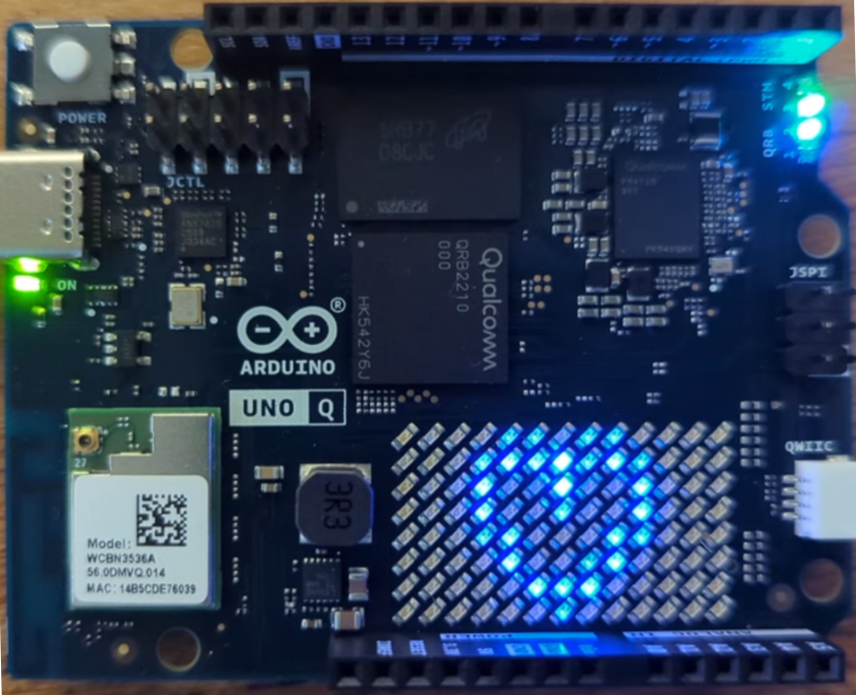
Getting to Know the Arduino UNO Q: Two Brains, One Board, and Zephyr Underneath
The Arduino UNO Q pairs a quad-core Linux processor with a real-time STM32 microcontroller on one UNO-shaped board, and quietly runs Zephyr where the classic Arduino runtime used to be. This guide takes an engineer's look at the architecture.
Derek Molloy
·
Jul 21, 2026
·
30 min read